
By Dr. Ryan Rumpf

In the last article, I presented some considerations for those wondering whether their program model is “educationally sound.” I ended the article by posing a question: “what would I do if I could start from scratch?” Thinking back, I’ve had that experience three times. Twenty years ago, I became the first ELD teacher at a young charter school outside Denver, where nearly everyone expected me to provide a “service.” I know the kids and I had fun in our modular classroom, but I struggled to decide what to focus on during our 30-45 minute classes. It just didn’t feel right.
The next year, I joined a team of teachers at a Marilyn Friend-led co-teaching training and used that model in three grades instead of pulling students out. Our Multilingual Learner (ML) state-test scores doubled in reading and tripled in math. My colleagues gave me the credit, but deep down, I knew the difference was them. That was when I began to understand that ML success was less about the service I provided and more about the bell-to-bell experience. Honestly, I started to question where I belonged in the whole system. My “service” just didn’t feel right.
Then I went to ’Nam to an international school where nearly every student’s first language was Vietnamese. Providing enough ELD “service” to everyone who needed it would have required an army of ELD teachers. I learned that services have limits, and they always will. That same period gave me another piece of the puzzle. During a mind-blowing visit to a school in Auckland, NZ, I saw a radically different educational approach. Teachers had broken the curriculum into clear learning progressions, students saw and owned their learning journey, and mastery, as opposed to time, determined when they moved forward. Learning was flexible, learner qualities were explicitly taught, and the entire process was visible in both English and Māori. I left with a borderline obsession trying to figure out what those practices could look like with integrated language development.
I sat on these ideas for several years, firmly believing that a mastery-based system built around agency and autonomy was the core of a true learning experience. I spent time at a State Education Agency where I had a 10,000-foot view of the system and some influence. However, despite a strong connection to many like-minded folks across the state, I was unsuccessful at persuading even the most innovative districts to give this style a shot. Eventually, I was hired to be the founding administrator of an elementary newcomer center and that is where this story takes off.
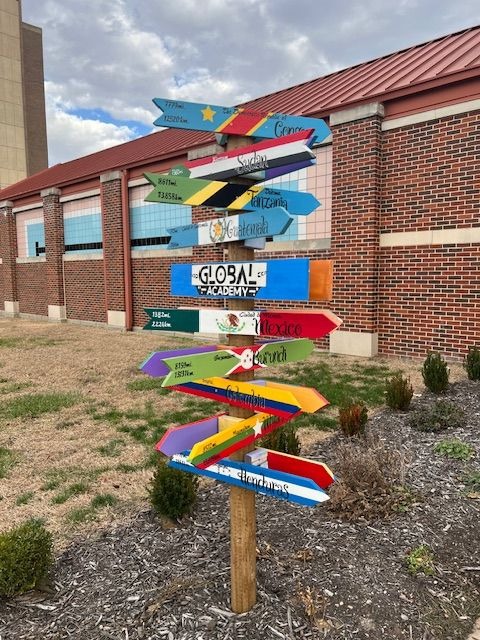
The entry sign to the Newcomer Center
The idea behind the newcomer center was to consolidate resources and wrap-around services. This was the opportunity I had been looking for; it was a dream job. I had the chance to take everything I had learned about language acquisition, learning, and program design and ask a fundamental question: what do newcomers, whatever their circumstances, need from school? This was a once-in-a-lifetime opportunity and one that I couldn’t possibly take on alone. (Shout out to the team – you are incredible!). To do this job well, we had to fill three different buckets:
| Language Acquisition | Cognitive Growth | A Soft Landing |
|---|---|---|
| Understand what they hear and read | Crystal clear learning targets | Facilitate place attachment |
| Talk and interact with others | See progress and next steps | Feel safe, supported, and happy to be at school |
| Use the home language to learn | Make sense of challenging content | Connect to people and resources |
| Notice how language works | Take ownership | Value their language and culture |
The structure went something like this. Students would be bussed from various neighborhood schools to the newcomer center for half a day. During that time, they would have English Language Arts (ELA), Math and English language development (ELD) classes. When the students returned to their neighborhood schools, they would spend lunch, recess, specials/electives, plus the remaining academic content with their grade level peers. This structure was entirely based on the “but-you’re-segregating-them” argument. (That’s a topic for another day)
To address the “they-are-missing-core-instruction” argument, we used the district’s curriculum and proficiency scales for ELA and math. All of the teachers were certified in elementary education and my role as the instructional leader gave us someone with the background and experience to effectively steer the newcomer ship. For ELD, the district had a popular newcomer-specific ELD curriculum. Structurally, at least, we had the first two buckets in place. But while many of the early conversations focused on schedules, curriculum, instruction and assessment, I found myself focused on something entirely different: what would all of this feel like?
I was thinking about the first experience with the families (enrollment). The first morning. Walking into an unfamiliar building. Meeting a teacher whose language you might not understand. Finding the bathroom. Knowing where to sit at lunch. Understanding what happens when I get on another bus after already being at school. All of it would likely be unfamiliar and for some, intimidating. The third bucket was, in many ways, the one that held everything else together. Comprehensible instruction, crystal clear learning targets and meaningful language development meant very little if students did not feel like they belonged or believe that they were capable of the work. They needed to want to come to school. They needed a successful experience early on and they needed to see this school as their place.
So what did we do? Our Welcome Center was staffed with “family liaisons” who could help parents understand the various forms and documents needed to enroll their children. We had the ability to interpret/translate for Burmese, Dari, Karen, Kinyarwanda, Somali, Spanish, and Swahili. When those folks were not needed for enrollment, they were in schools. We gave a tour to everyone who walked through the doors. Families walked the halls where they would find strategically placed cultural exhibits. They could meet their teacher, our social worker and nurse. They could visit our clothes closet and food pantry. The last stop was our multilingual library, a space we continuously filled with native-language books that we were able to provide through our community partners, grants, and fundraising. The library wasn’t just part of the welcome either. We wanted students reading; specifically, reading for pleasure. We even got pen readers and dual-language books from Language Lizard for students who were emerging readers in their home language.
Take a moment and imagine that. A family left their home country, likely under difficult circumstances, and relocated somewhere where the dominant language is new. They needed to get their kids in school and showed up at our Welcome Center. They were met by someone who spoke their language, got to tour the building, met the people that would be taking care of them, stocked up on necessities, and the last thing they got to do was walk away with a folder of information and a book to read in their home language. I’m not saying everything was rainbows and unicorns. We had just experienced a pandemic. There were challenges. Life certainly was not easy for our families either, but their experience with us was positive.
The biggest challenge was core academic instruction. Our students came to us with a huge range of prior learning experiences. Some had clearly experienced strong, consistent schooling, while others had clearly not been in a school at all. We had the full range. And they didn’t all come at the same time; rather, they came in “waves” throughout the year. The standard August-May curriculum would never meet our students where they were, nor would placing them in traditional grade level classrooms.
My experience at the school in Auckland taught me that there was another way. We didn’t have to use grade levels or an August-May curriculum. I needed the teachers to see that too, but I knew I couldn’t come out and say it, at least without everyone feeling the need to do something. That’s not how innovation happens in large organizations, especially schools. I needed them to feel the sense of urgency to improve. Only then could we do the work together. Fortunately, one absolute rockstar of a teacher had tried something similar before, she was persuasive, and she jumped at the opportunity to do it in our space.
At the time, we stayed late for an hour and a half every Wednesday for Professional Learning Community (PLC) work. I came prepared with every proficiency scale in our district’s math curriculum. We taped them by skill vertically on the wall with kindergarten on the bottom and 6th grade on the top. The process allowed us to develop a learning progression that encompassed every priority skill in our district. You may think that these were incredibly long. They weren’t. It really is amazing how many skills are repeated through the grades. The idea was that we would find a starting point for each child and set a goal to work our way up to grade level in a defined period of time. Every 6(ish) weeks, we re-organized students and classrooms. They were all our students and each student deserved to work on the skill they were ready for. One teacher supported all new students, one teacher supported the students that were nearing exit and the others adjusted as needed.
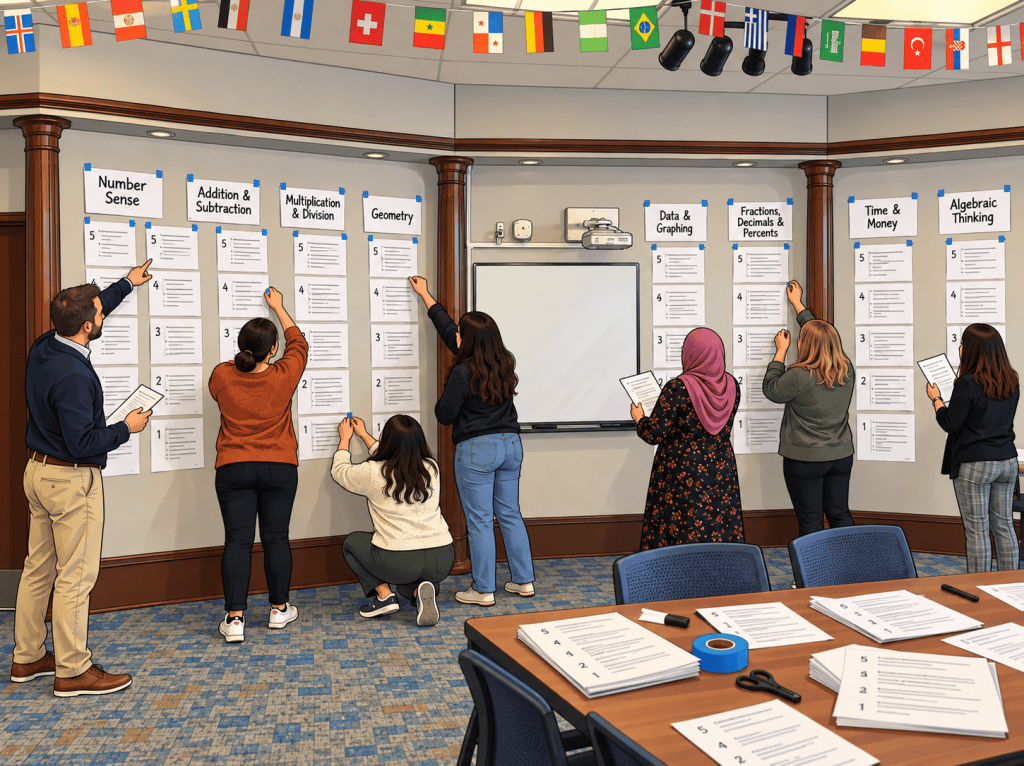
An AI generated image based on a real picture. Staff are pasting proficiency scales vertically on the wall.
At this point, we had our system. Now we needed to teach it to the students. They had to be able to see it and what their role was in it. And importantly, they had to own it. In a system like this, students are in the driver’s seat. The teachers show them the way and guide them through it. There was a practical reason to build this independence too: eventually, every student would return to their neighborhood school full time. They would need this confidence and independence when they left us. So we had to explicitly teach them skills such as being goal-driven, persistent, and responsible.
We also had to make sure the learning targets were crystal clear, which turned out to be quite the challenge. For years, I had told anyone who would listen that half the battle with newcomers is them understanding exactly what it is we want them to learn. And in this case, that meant understanding the steps in their learning progression and the criteria they needed to meet to show mastery. Doing that is easier said than done. Pictures, modeling, and demonstrations will work for some skills; those that are easy to see. However, more abstract skills like justifying, arguing, and persuading need comprehensible words to go alongside the visuals. Newcomers, especially those taking their first steps in English, are not yet ready to access that kind of language in English. If they are truly going to wrap their heads around the learning targets, that first touch in the new skill needs to be in the native language. And with a largely English-speaking staff and multiple languages in the room, it seemed impossible. Perhaps coincidentally, we were grappling with another challenge at the same time, and its solution opened the door to providing clear, accurate, and accessible first exposures to new academic content.
In late 2021, we were in the middle of the Afghan “wave.” We welcomed dozens of new Pashto- and Dari-speaking families. Apparently, so were many other districts across the country. Getting a Pashto- or Dari-speaking interpreter on the phone could take hours. When a bus driver told me a group of Afghan students saw her cresting a hill and ran at her down the middle of the road, I had to get that figured out. I called them all to my office, and after a long, and ultimately unsuccessful wait for an interpreter, I tried drawing pictures and acting things out. They just laughed at me. I sent them back to class and started looking for a solution. Then I found a video dubbing service called Maestra.ai. I signed up for the free trial, made a one-minute video using my computer’s camera and one of the pictures I had just drawn, and had Maestra dub it into Pashto. I had no idea if it was accurate or not, but it was worth a shot. I called the students back in and showed them the video. They started talking seriously with each other then a couple students looked at me and gave a thumbs-up. We never had that issue again.
Naturally, I started thinking about how this tool could be used for instruction. The students starting a skill with a video ended up solving two problems. It gave us an opportunity to provide the “first touch” on a new skill in the native language, and it multiplied the teacher to every laptop in the room. It’s easy to give students less rigorous activities while working with a small group. Sometimes, we needed to do that to keep kids busy. With the videos, we had a way to keep them focused on our learning goals. Once we learned that the video needed to end with a “do next” activity (otherwise they just sit there or start playing), the teachers could spend an entire 15-20 minute block of time focused on a small group or individual instruction while the others were meaningfully engaged in something academic. Then, we could switch and keep the cycle going throughout the day.
After we had this going for a bit, I realized that the three buckets I was originally looking for had stopped feeling like separate parts of the program. Students were receiving meaningful, comprehensible content area instruction. The videos weren’t the language-development program, though. They made academics accessible. We had already built in “morning meetings” at the beginning of each session and some teachers were already doing things like inside-outside circles to put kids into situations where they needed to use language to accomplish a goal. Our experience with GrapeSEED with the younger students helped us see how that same idea could be applied to academics through choral reading, total physical response and dictation activities. Eventually, we began each day with predictable language routines designed to get everyone listening, speaking, and interacting almost immediately. Those routines changed as we learned what worked, but the expectation did not: language was something students did, not something we delivered to them.
While the videos could make new content comprehensible, the routines gave students opportunities to do something with that understanding. They were interacting with one another and their teacher every day. We had nearly seamlessly integrated language development into language arts and math. Our students were happy. And they grew. After three years, we analyzed relevant data. Students spent an average 8.7 months in our program. During that time, the average exit score on the WIDA MODEL was a 2.3 overall – that’s a gain of 1.3 proficiency level points in a little less than a year.
Looking back, there was one thing all of those earlier experiences had in common: I was always trying to improve ML education within a system someone else had already designed. I could change my service, collaborate differently, or introduce new strategies, but the larger system stayed the same. The newcomer center was different. For the first time, I wasn’t being asked to fit a program into an existing system; the system was willing to change to accommodate the program. The decision-makers wanted an instructional program focused on what students needed to learn. In the end, the team and I built the experience around what students needed in order to learn. Those are two different things. And perhaps that is where this entire series has been leading. History helps us understand how we got here. Civil Rights law tells us what multilingual learners are entitled to and research helps us understand what they need. What they experience when they walk through the doors is up to us.


Leave a comment