
Ryan Rumpf, Ed.D
June 26, 2026
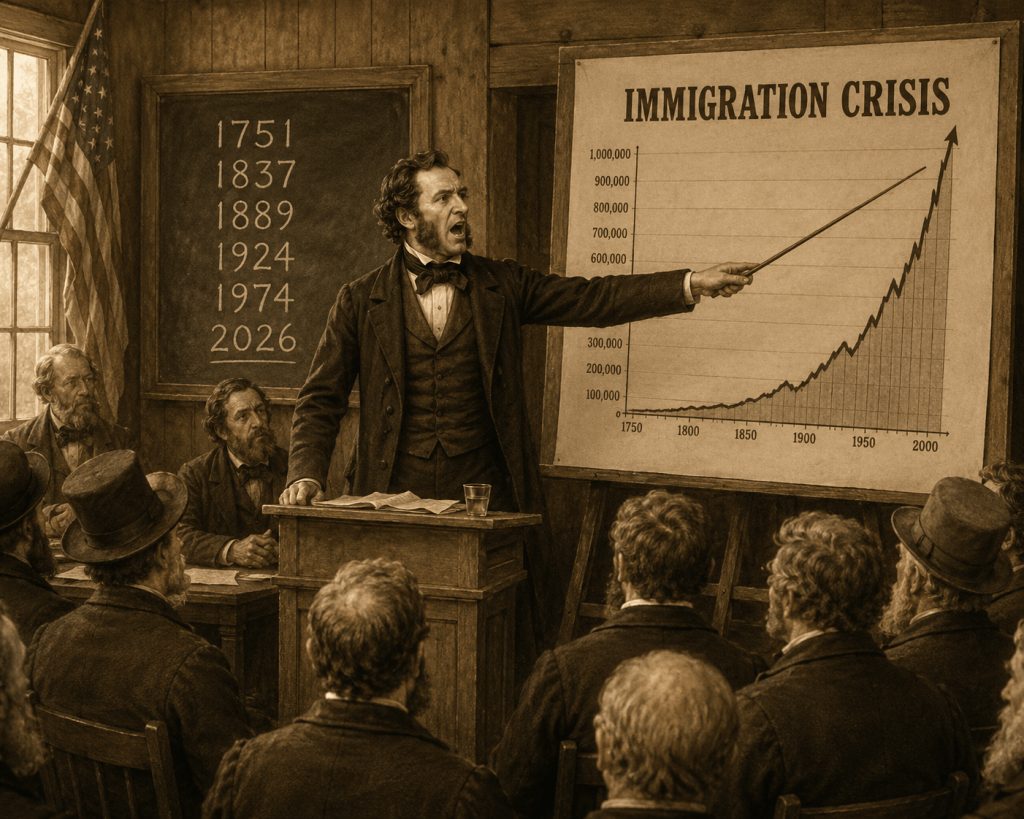
Turn on the news, scroll through social media, or listen to a politician speak, and you might conclude that the United States is facing a dire, unprecedented challenge: immigration and national identity. The political world often wants it that way. Right, wrong, or indifferent, immigration is an issue that sparks strong emotions and much like other areas in our society, schools often get drawn into these debates.
I have worked in education since 2003, as a bilingual educator of Multilingual Learners (MLs). I am also an unapologetic history buff frequently studying our past to better prepare for solving challenges today. When I hear someone say that immigrants need to “learn English” or “become American,” I can’t help but think to myself: we’ve heard this before. Immigration, language and national identity are not new debates or concerns. Human migration is as old as humanity itself. The issue has been so historically prevalent that most of the world’s religions weighed in, long ago, by insisting that foreigners be treated with dignity and compassion. How we are doing in that regard is a topic for another day.
After the “discovery” of the new world, what is now the United States was a land filled with indigenous people speaking hundreds of languages. In the first few centuries after the “discovery,” the land saw massive immigration from many countries in Europe and the forced migration of millions of Africans through the slave trade. Even then, passionate debates evolved about language, culture, and what would eventually become questions of American national identity. Benjamin Franklin, one of the most famous founding fathers, was multilingual, speaking English and French fluently, with some proficiency in Latin, Italian and Spanish. Yet, he was adamantly opposed to large immigrant settlements. In 1751, he wrote and published Observations Concerning the Increase of Mankind, which revealed the existing debate over immigration, language and national identity.

He claimed that a successful nation naturally replenishes itself; that population growth comes from births, not immigration. The Palatines he references were early 18th-century German-speaking refugees from the Palatinate region of the Holy Roman Empire. The use of the term “Boors” was not intended as a compliment. The part that jumps out at me is this:
“why should Pennsylvania, founded by the English, become a colony of Aliens, who will shortly be so numerous as to Germanize us instead of our Anglifying them, and will never adopt our language or customs…?”
In this short excerpt, one of the most influential colonial leaders, technically a second generation immigrant himself, dismisses an entire group of German-speaking immigrants with an ethnic insult while questioning whether they would ever adopt the language and customs he believed should define the colonies. I’ve heard something like that before.
Now, what about the intersection with education? If you travelled across the colonies in 1776, you would find a patchwork of “schools” that varied dramatically by region. From the founding of the country through much of the 1800s, schools routinely taught in languages other than English. Depending on where you lived, instruction could have been in English, German, Dutch, French, Swedish, Polish, and a few others; sometimes in the same building. In what is now the American Southwest, the language of schooling was Spanish, a reminder that English was not always the default language in every part of North America.
In the 1830s, Ohio was experiencing a population boom and the topic of public education was front and center, as the idea of common schools was gaining traction. Common schools were the predecessor of public education and unsurprisingly, language and national identity were a part of the debate. Calvin Stowe, a professor in Cincinnati (and husband of Harriet Beecher Stowe), had just returned from studying the education system in Europe. Universal education was a thing there, and Prussia, in particular, was highly regarded for their system. Knowing that Stowe had just returned, and that he was a respected scholar, the State legislature requested a report. It was a powerful moment and highly influential in the development of “common schools.” The entire report is fascinating – class sizes at less than 10 per teacher, the respect deserved by teachers, the scope and sequence of the curriculum by age clusters, and much more. My eyes naturally caught on to the following excerpt:
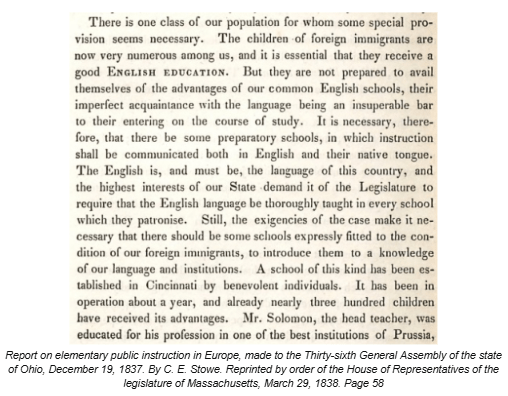
At first glance, Stowe’s recommendations appear straightforward. He believed English should be the common language of the United States and that immigrant children should learn it as quickly as possible. Yet a closer reading reveals something more nuanced. Stowe recognized that many newly arrived children could not access instruction delivered entirely in English. Rather than viewing their native languages as obstacles to be ignored, he recommended preparatory schools where instruction could be delivered in both English and the child’s home language until they were ready to participate in the common schools. Nearly two centuries before today’s debates about bilingual education, language support, and newcomer programs, educators were already wrestling with the same practical challenge: how do you teach students who are still learning the language of instruction?
A lot happened between this report and now. In the late 1800s and early 1900s, assimilation was the goal, both socially and in education. Native American children were forced into “boarding schools” to assimilate to American culture. This period also saw the Americanization movement in which nonprofit organizations offered classes intended to help immigrants assimilate to American life, particularly through English language classes. One of the largest providers, the YMCA, offers English classes at certain branches today. Over time, the Americanization efforts expanded into government programs and public schools, where immigrant children were separated from their English-speaking classmates (and sometimes schools) to “learn English.”
The Americanization Movement’s approach may seem to accomplish what Stowe recommended nearly a century before. However, the distinction between the two is important and comes into play with educational decisions today. Stowe’s concern was access to academic instruction while students learned English. The Americanization movement increasingly focused on teaching English rather than ensuring access to academic learning. I’ve heard something like that before.
Then we get to the Civil Rights era, which drastically changed the course of our story. Public schools in some regions, especially those with high numbers of non-native English-speaking students, developed systems in which students who looked and sounded differently were forced to attend a different school. This was a widespread practice in the American Southwest at the time and eventually the people objected. There was the Lemon Grove Incident and the Del Rio ISD case. In 1944, the Mendez family sued their local school that forced their English-speaking children to attend a “Mexican school,” leading to a landmark federal court decision. There are many moments in our history where parents and communities stood up for their language and culture, too many to name here.
In 1966, the National Education Association, published a landmark report documenting that Spanish-speaking students consistently scored well below their English-speaking peers and experienced disproportionately high dropout rates. The report argued that schools were largely ignoring the linguistic needs of these students. In the early 1970s, thousands of Chinese-American students were in classrooms where they were expected to learn academic content despite being unable to understand much of the instruction. Some did fine, many didn’t, and their parents questioned whether simply placing them in a class like everyone else was fair to their children. We’ve heard something like this before.
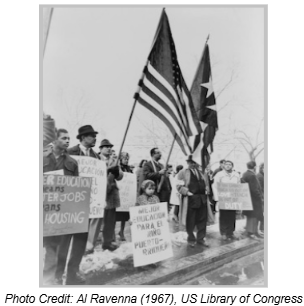
Those Chinese-American parents sued and it led to a landmark Supreme Court Ruling. In 1974, Lau v. Nichols established that providing the same instruction to students who could not understand English did not constitute equal educational opportunity. By not addressing the language barrier, students were “deprived of a meaningful education.” It did not, however, mandate a specific program or action. Seven years later, Castañeda v. Pickard created a three-part framework requiring language assistance programs to be based on sound educational theory, implemented effectively, and evaluated for results. Again, no real decisions were made about how to best educate immigrant children, just an exceedingly broad set of mandates that continue to be open to interpretation.
To this day, we continue many of the same debates over language and its place in the development of our youth. Hopefully, you can see how these things are not new. How much should immigrants adapt and how quickly? What role should schools play? Is English taught separately from the general curriculum or as an integral part of it? How often are students sitting in classes (or taking tests) that they have no chance of understanding? What do we do about it? The answers have ebbed and flowed dramatically over time. Nearly 275 years after Franklin published his concerns about Germans, we are still debating many of the same issues we’ve heard before.
To be continued…
Coming Next: From Courtroom to Classroom: Exploring the Layers of Educational Decision-Making

 Global Educators
Leave a comment