
By Dr. Ryan Rumpf
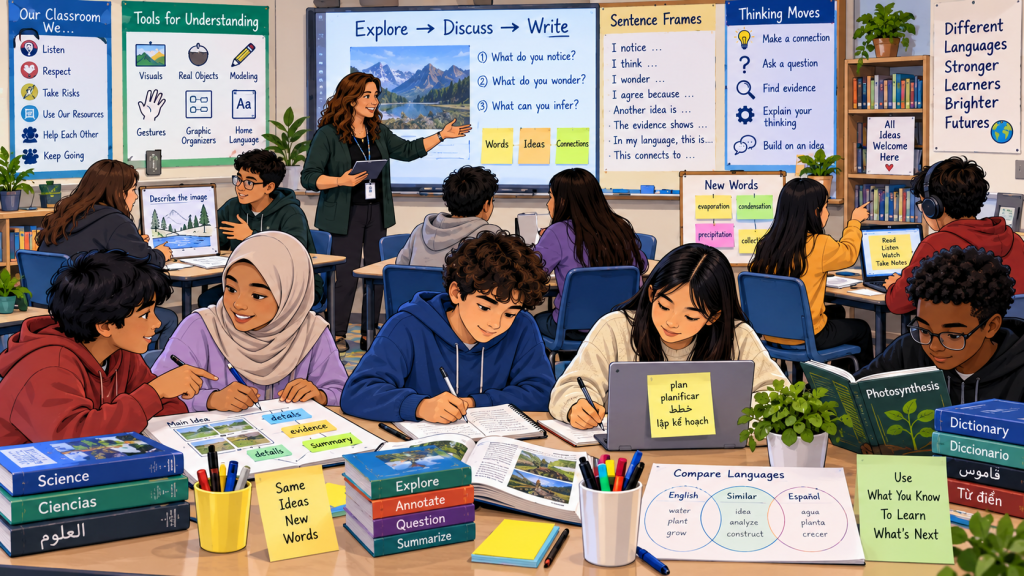
So far in this series, we have hopefully learned two things: 1) immigration and language policy has been debated for centuries and 2) actual language policy with which schools need to comply are layered and debatable. While I find both of these complex issues interesting, they do not do much to help students grow nor do they make the work of teachers more efficient. In fact, they do little more than add to plates that are already full. So, what will help those heroes in the classroom? This article will explore the most important concepts that teachers must understand to design a meaningful experience for their students who are at any point in their journeys in English.
Perhaps some readers were once a student in a similar situation to today’s multilingual learners. Think carefully, what was it that helped you “pick up” English? Perhaps some readers were once a student in a World Language classroom. What was that experience like? Are you able to use that language today? Why do you think that is? Importantly, for both scenarios, how much did you rely on your first language as you were “picking up” your new language?
My first experience in a new language was my freshman year in high school. I loved it. From my freshman year through college, my Spanish classes (and German and French) consisted of about the same things. We had long lists of vocabulary to memorize. Throughout each unit, there were readings, lots of grammar activities, and a unit test at the end. I admired my teachers and enjoyed the coursework. I could explain all the grammar and tell you many words on command. There was just one problem: after several years of these classes and B.A. in Spanish, I couldn’t engage in many substantive conversations with other speakers which was a major issue considering I was about to begin a career where I would soon be asked to communicate with students and parents.
Today, I consider myself fairly fluent in Spanish. I still stumble on situations where I don’t quite have the words or mastered the grammar, but I frequently get a lot of confused looks from native Spanish speakers after finding out I am a native English speaker from rural Missouri. Sure, the educational background has helped me, but I can definitively say that my abilities to communicate in Spanish largely came through using it daily in authentic situations with others, reflecting on the experiences, and picking up bits and pieces over time. I remember most things by either making connections with my first language or to other concepts I already understand in that language.
That should help provide a baseline for what our multilingual learners really need. Humans have been learning other languages for our entire existence – some argue our brains are wired for it. For much of human history, pure immersion and the pressure to communicate provided the motivation and context necessary to “pick up” another language. One of the earliest formal approaches to foreign language instruction became known as the Grammar-Translation Method. Students would read in the target language, translate the sentences, and repeat. As you can imagine, it was tedious and for the most part, poorly suited to developing genuine communication.
Other methods came and went; if you are interested, feel free to check them out. A major breakthrough in second language acquisition came in the late 1970s and early 1980s when Dr. Stephen Krashen proposed a theoretical model intended to explain how people acquire additional languages. The key components of his “hypothesis” were:
| Component | Description | Classroom Application |
|---|---|---|
| Language Learning vs. Language Acquisition | Learning is conscious knowledge about a language: rules, vocabulary, and grammar. Acquisition develops more naturally as learners use language to understand and communicate meaning. | Teach language explicitly when useful, but create frequent opportunities for students to use English for a real purpose, such as explaining, questioning, describing, solving, reacting, and creating. |
| Natural Order | Some language features tend to develop before others. Learners do not acquire every grammatical structure simply because it has been taught. | Don’t expect immediate mastery of every language form. Model, recast, scaffold, and revisit language while allowing students to communicate with the language they currently have. |
| Comprehensible Input | Learners acquire language when they understand messages, including language that stretches somewhat beyond their current level. | Consider what is being presented to students and what they are asked to do. Then ask, “Is this at a level that this student can do?” If not, how can I help them understand through visuals, videos, modeling, home-language support, or other scaffolds? |
| Monitor | Conscious knowledge of language rules can help learners notice and correct their own language, but excessive monitoring can interfere with communication. | Separate opportunities for fluency from opportunities for precision. Sometimes students should communicate freely; other times, ask them to reread, revise, edit, or improve their language. |
| Affective Filter | Stress, anxiety, embarrassment, and low confidence can interfere with a learner’s willingness and ability to engage with language. | Build predictable routines and a classroom where mistakes are safe and students feel like they belong. Ask: How can we make sure the student feels both challenged and successful? |
For me, Krashen’s ideas form much of the foundation of my work. I believe language is largely acquired and partially learned. The more students learn about the language, the better they can reflect and refine, but overall, language is picked up naturally based on the conditions that we create and the tasks we design for them. And due to the affective variables, it is all very fragile, especially at first. A bad day or negative experience can linger for a long time and if those negative experiences consistently repeat themselves, students will withdraw. Anyone would.
While Krashen’s work certainly wasn’t without criticisms or shortcomings, these ideas remain enormously influential. Some researchers and academics have extended his ideas to encompass other crucial components of language acquisition or they have proposed other important considerations for effective language acquisition. The following are important understandings that extend the ideas or add missing parts:
| Component | Description | Classroom Application |
|---|---|---|
| Interaction | Language develops through interaction with others. Learners negotiate meaning by asking questions, clarifying, responding, and adjusting what they say when communication breaks down. | Design structured student-to-student interaction, not simply teacher questioning. Information gaps, barrier games, partner retells, collaborative problem solving, and “stronger and clearer each time” routines give students reasons to communicate. |
| Noticing | Learners are more likely to develop language when they consciously notice words, patterns, and structures in the language around them. | Draw attention to language within meaningful content. Ask students to notice how an author connects ideas, how a speaker expresses disagreement, or which words make an explanation more precise. |
| Comprehensible Output | Learners need opportunities to produce language—not merely understand it. Trying to communicate pushes learners to recognize gaps between what they want to say and what they can currently express. | Give students frequent opportunities to speak and write, receive feedback, and try again. Move from rehearsal and supported production toward increasingly independent and precise communication. |
A classroom built around these principles would be a pretty good place to learn a language, and frankly, any academic content as well. Imagine a student, who has only experienced school in Arabic, walking into a classroom where everyone speaks English. Fortunately, there is an Arabic-speaking student in the class already and she is willing to be a mentor. The teacher designs lessons where everything is accompanied by a picture. All tasks are modeled first and directions remain visible throughout. The teacher repeats major points in simple sentences and short phrases while frequently referring back to an image. She is careful about how fast she talks and the words she uses. There is planned discussion time so the new student has time to talk through the content with the mentor. The new student gradually builds confidence and is praised for using English although the grammar may be a bit off. But there is still an enormous resource in the room that we haven’t addressed yet: the languages students already know.
If you recall in my reflection on my experience with Spanish, my brain did not somehow shut off English when I encountered Spanish. I was (and still am) frequently making connections between the two. I notice cognates, compare sentence structures, and so on. Sometimes, English helps me understand Spanish and honestly, sometimes Spanish helps me understand English. I didn’t know the English word “edifice” existed until I learned the word “edificio” in Spanish. The same is true for the names and purposes of several grammar structures (ie. the subjunctive mood). And what should not be too surprising, the research community has consistently backed this up for decades; although, the periodic culture wars over this topic entirely ignores it. A few highlights from the literature are:
| Component | Description | Classroom Application |
|---|---|---|
|
Linguistic Interdependence Principle
Also see: Common Underlying Proficiency |
Languages are not completely separate systems. Knowledge and abilities developed through one language can support development in another. | Students can learn or review a concept in their home language before engaging with it in English, rather than learning both the concept and English at the same time. |
| Language Transfer | Knowledge from one language can influence the learning and use of another. Concepts, literacy skills, vocabulary, sounds, grammatical patterns, and strategies can transfer across languages. | Invite students to compare languages. Explicitly point out cognates and cross-language comparisons. AI can also help identify useful similarities and differences when you are unfamiliar with a student’s language. |
| Additive Bilingualism | Acquiring an additional language does not require replacing the first. | Treat the home language as an asset rather than competition for English. Replace “English-only” class policies with purposeful opportunities to use home languages. |
| Translanguaging | Learners draw flexibly from their full linguistic repertoire to understand, think, communicate, and learn rather than keeping languages rigidly separated. | Allow students to brainstorm and research in one language and write or discuss in another. Read an English text and annotate in the home language. Let students use all of their linguistic resources to make meaning. |
The classroom I described earlier is a nice option for a student in an English-only classroom; however, many teachers can attest that some students, particularly those early in their English journey, will struggle for a while. They may not be able to understand everything but with a strong, passionate teacher, will not get too far “behind.” Now let’s imagine that same classroom. The teacher is welcoming and purposefully designs lessons that maximizes the chance that the new student will understand what’s going on, except this time, there are embedded native language supports.
The teacher has developed a student-friendly learning progression for the unit and had AI translate it to Arabic. The student has the opportunity to understand exactly where they are and where they will be going. That clarity is highly beneficial to any student. Each concept on the progression has a video, in Arabic, modeling the skill which the student is asked to watch at home, ideally with parents, and has an accompanying practice sheet. How you do this is a topic for another day, but know that it is possible and surprisingly easy. When the student walks in, she has already developed some foundational knowledge about the day’s objective. During the typical Think-Pair-Share time, the student can talk with her mentor in Arabic. The “exit tickets” could be in Arabic or English. Sometimes the teacher needs to know, “does this student understand photosynthesis?” Other times, the teacher needs to know “can this student explain photosynthesis in English?” Those are different questions, and our assessments can be designed for both. We do have tools that can evaluate student responses in just about any language.
The student participates in the same class as her classmates. She is going to develop English-speaking skills just as she would in the English-only classroom, except this time she is better prepared. She is at least maintaining her home language and she now has another powerful resource for making sense of English, which has the potential to speed up her abilities in English. There was a lot packed into this article, perhaps its best to summarize it like this: when designing a lesson for multilingual learners, ask:
- Can students understand what is happening? (input)
- Do students have meaningful opportunities to use language? (interaction/output)
- Am I allowing students to use what they already know, including the other language? (multilingualism)
At this point in the series, we have learned our complicated history with languages and immigration, what the government says about it and the concepts needed for effective language development. But remember, the government doesn’t mention any of these things. They say that multilingual learners are entitled to a language instruction program that is 1) designed on sound educational theory, 2) sufficiently staffed with adequate resources and 3) periodically evaluated for effectiveness. The next article will explore effective models and which are most commonly used. You may be surprised…
To be continued…

 Global Educators
Leave a comment